



20 Jun Infrastructure Development and Its Impact on Property Investment: Why Townsville Is Emerging as a High-Growth Regional Market
Townsville is undergoing a significant transformation driven by large-scale infrastructure investment, diversification into renewable energy, and sustained population growth. These factors are combining to reshape the city’s economic base and strengthen its position as one of Queensland’s most strategically important regional centres.
For property investors, infrastructure-led growth markets like Townsville are closely watched due to their ability to generate long-term demand for housing, support rental performance, and drive capital appreciation over time. The scale of current and planned projects signals a shift toward a more resilient and diversified economy, underpinned by healthcare, defence, energy, and logistics.
Major Infrastructure Projects Driving Townsville’s Expansion
A defining feature of Townsville’s growth story is the volume and scale of public and private infrastructure investment. These projects are not only expanding capacity across essential services but also generating employment and reinforcing long-term economic stability.
Healthcare Expansion Supporting Population Growth
One of the most significant developments is the expansion of the Townsville University Hospital. A $530 million multi-storey clinical building is increasing healthcare capacity, improving specialist services, and supporting the region’s growing population.
Healthcare infrastructure is a key long-term economic stabiliser for regional cities. It supports skilled employment, attracts professionals, and increases demand for residential housing in surrounding suburbs. As medical services expand, so too does the need for nearby accommodation for workers, patients, and supporting industries.
Defence Investment Strengthening Economic Security
Townsville is also benefiting from a substantial $1.5 billion defence investment across Army, Airforce, and Navy facilities. Defence expansion plays a critical role in regional economies due to its long-term funding cycles, stable employment base, and demand for local procurement and services.
This type of infrastructure typically creates sustained housing demand from both defence personnel and civilian contractors, particularly in well-connected residential areas near bases and transport corridors.
Port Modernisation and Trade Growth
Another major catalyst for economic activity is the $232 million expansion of Port of Townsville. The modernisation project is designed to increase trade capacity and strengthen the logistics and freight sector.
Port infrastructure is a key driver of regional economic development. It supports import and export activity across agriculture, mining, and manufacturing sectors, while also generating construction jobs during the build phase. The expansion is expected to support thousands of construction roles and significantly increase long-term trade throughput, reinforcing Townsville’s role as a northern logistics hub.
Townsville’s Transition Into a Renewable Energy Powerhouse
Beyond traditional infrastructure, Townsville is positioning itself as a leader in Australia’s renewable energy transition. This shift is diversifying the local economy and creating new employment pathways in advanced manufacturing and clean energy production.
Green Industrial Development and Clean Manufacturing
The Lansdown Eco-Industrial Precinct is a $50 million renewable energy and clean manufacturing hub designed to attract sustainable industries and support low-emissions industrial growth.
Eco-industrial precincts are increasingly important in regional economic planning. They create long-term employment opportunities while also positioning regions to participate in global supply chains focused on clean energy and sustainable production.
Solar and Wind Energy Expansion
Townsville is also benefiting from large-scale renewable energy investment, including solar farms such as the Ross River Solar Farm and proposed wind energy developments that could become among the largest in Australia.
These projects contribute to energy security and support the transition away from fossil fuels. They also generate construction and operational employment, particularly in engineering, maintenance, and technical services.
Hydrogen and Battery Materials Investment
A key milestone in Townsville’s energy transition is the $70 million Federal investment in a Hydrogen Hub, positioning the region as a strategic participant in Australia’s emerging hydrogen economy. Hydrogen production is expected to generate skilled jobs and attract international interest in green fuel exports.
Further strengthening this industrial shift is the approval of a $2 billion battery materials plant supplying electric vehicle manufacturers such as General Motors. In addition, a $75 million rare minerals processing facility is expected to create thousands of jobs and support global supply chains for critical minerals.
These developments place Townsville at the centre of Australia’s clean energy and advanced manufacturing future.
The Investment Potential: Jobs, Growth, and Economic Resilience
The scale of infrastructure investment in Townsville is directly translating into employment growth and economic expansion. Thousands of jobs are being created across construction, defence, healthcare, logistics, and renewable energy sectors.
Major projects collectively contribute to an estimated $34.31 billion in economic output, supported by approximately $12 billion in ongoing construction activity. This level of sustained investment is rare for a regional centre and reflects strong confidence in Townsville’s long-term growth trajectory.
Economic diversification is a key strength of the region. Unlike single-industry towns, Townsville benefits from a balanced mix of defence, mining, healthcare, education, logistics, and energy. This diversity helps reduce exposure to sector-specific downturns and contributes to more stable economic performance over time.
Connectivity improvements such as the $50 million investment in the Mount Isa to Townsville rail corridor further enhance freight efficiency and regional integration, strengthening Townsville’s role as a key logistics gateway in Northern Australia.
The Rental Market and Capital Growth Potential in Townsville
Tight Rental Conditions Driving Strong Demand
Townsville is currently experiencing a highly constrained rental market, with vacancy rates near 1%. This reflects a broader rental shortage across Queensland, but is particularly pronounced in regional centres experiencing rapid employment growth.
Low vacancy rates indicate strong demand for housing, especially in areas close to major employment hubs such as hospitals, defence bases, industrial precincts, and the port. As supply remains limited, rental prices have been increasing, placing upward pressure on yields.
For investors, these conditions typically signal strong rental performance driven by structural undersupply rather than short-term market fluctuations.
Population Growth Supporting Long-Term Capital Appreciation
Townsville’s population is growing at approximately 2.1% annually, a rate that continues to underpin housing demand. Population growth is one of the most important drivers of long-term property value appreciation, particularly when combined with infrastructure-led employment expansion.
As more workers relocate to the region for defence, healthcare, construction, and energy sector roles, demand for both rental and owner-occupier housing continues to rise.
Historically, regional markets undergoing similar growth cycles have often outperformed capital cities in percentage terms during key development phases. While market cycles vary, Townsville’s current trajectory reflects many of the conditions associated with sustained capital growth over time.
The Advantages of Investing in Regional Markets Like Townsville
Regional centres such as Townsville often present distinct advantages compared to major metropolitan markets, particularly during periods of infrastructure expansion and economic diversification.
More Accessible Entry Points
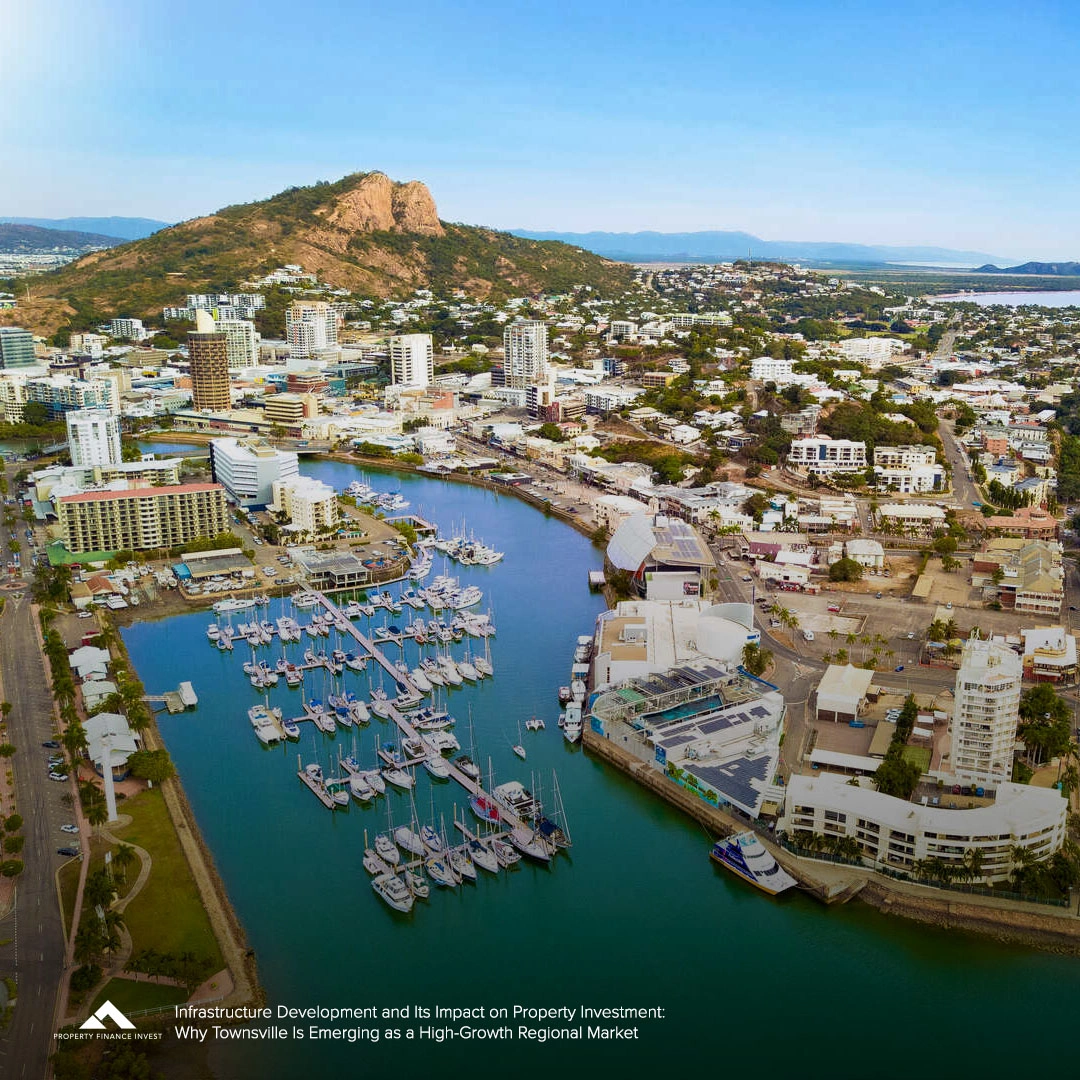
Property prices in Townsville remain more affordable than those in capital cities such as Sydney and Melbourne. This allows for greater accessibility for investors seeking exposure to growth markets without the high entry barriers associated with metropolitan assets.
Stronger Rental Yields
High rental demand combined with limited supply often results in stronger rental yields compared to more saturated capital city markets. This is particularly evident in areas close to key infrastructure projects, where demand is consistently higher.
Long-Term Growth Potential
The combination of sustained infrastructure investment, population growth, and economic diversification positions Townsville for continued long-term development. Markets with these characteristics tend to attract ongoing investor interest due to their ability to deliver both income and capital growth over extended periods.
Outlook for Townsville’s Property Market
Townsville is entering a phase of structural transformation driven by infrastructure, energy transition, and demographic growth. The convergence of defence expansion, healthcare investment, port modernisation, and renewable energy development is reshaping the city’s economic foundation.
These conditions typically support strong fundamentals in residential property markets, particularly where housing supply remains constrained and employment growth is sustained.
As Townsville continues to evolve into a key industrial and energy hub for Northern Australia, its property market is likely to remain closely linked to infrastructure delivery and population inflows. For investors monitoring regional growth corridors, Townsville represents a market where long-term structural drivers are becoming increasingly aligned.